
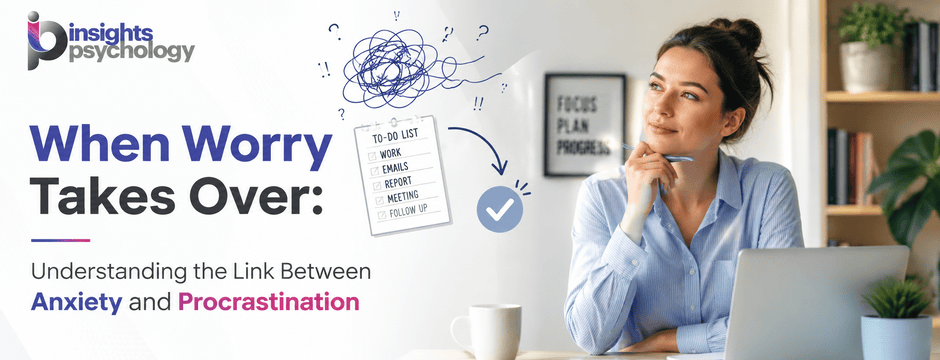
You know the task matters. You may have already written it on a list, set a deadline, and promised yourself that today will be different. Still, every time you try to begin, something inside you pulls back.
You check your email. You reorganize a drawer. You watch one more video. You tell yourself that you will start once you feel more focused, confident, rested, or prepared.
Hours pass, the deadline gets closer, and the worry becomes harder to ignore.
This experience is often dismissed as laziness or poor time management. In reality, the connection between anxiety and procrastination can be much more complicated. For many people, delaying a task is not about a lack of concern. It happens because they care so much about the outcome that starting feels emotionally threatening.
Procrastination may provide a few minutes or hours of relief, but the unfinished task remains. As pressure builds, so do guilt, self-criticism, physical tension, and fear of failure. What began as an attempt to avoid discomfort gradually becomes a cycle that creates even more anxiety.
Understanding that cycle can help you respond with greater clarity and less shame.
Procrastination Is Not Always a Motivation Problem
People often assume that procrastination happens because someone is unmotivated, careless, or undisciplined. That explanation may fit some situations, but it does not capture what many anxious people experience.
A person can be highly motivated and still feel unable to start.
You may genuinely want to complete the presentation, submit the application, make the phone call, clean the house, or respond to an important message. At the same time, the task may trigger thoughts such as:
- What if I make the wrong decision?
- What if my work is not good enough?
- What if people judge me?
- What if I become overwhelmed?
- What if I cannot finish once I begin?
- What if this proves that I am not capable?
These thoughts can make an ordinary responsibility feel like a threat.
Anxiety often involves worried thoughts, physical tension, difficulty concentrating, restlessness, and a sense that something may go wrong. When these reactions become intense, the brain may focus less on completing the task and more on escaping the discomfort associated with it.
That is one reason procrastination may function as an emotional coping strategy rather than a simple scheduling failure.
Why Anxiety Causes Procrastination
To understand why anxiety causes procrastination, it helps to look at what happens in the moments before avoidance.
Imagine that you need to prepare a report. The task is important, visible to other people, and open to evaluation. As you think about beginning, your mind starts predicting problems. You picture overlooking something important, receiving criticism, or discovering that the work is harder than expected.
Your body responds as though the threat is already happening. Your chest may tighten. Your thoughts race. You may feel restless, mentally foggy, or unusually tired.
Then you postpone the task.
The moment you decide, “I will deal with it later,” some of the discomfort decreases. That temporary relief teaches the brain that avoidance works. The next time the task appears, the urge to delay may become even stronger.
Psychologists recognize that avoidance can reduce distress in the short term while maintaining or worsening anxiety over time. Avoiding an uncomfortable situation prevents a person from learning that they can tolerate the feeling, manage the task, or survive an imperfect outcome.
The issue is not that the person does not want to act. The issue is that action has become linked with emotional danger.
Understanding the Procrastination Anxiety Cycle
The procrastination anxiety cycle usually develops through a predictable sequence:
- A task triggers worry, uncertainty, or fear of judgment.
- The person imagines negative outcomes.
- Anxiety makes starting feel difficult or unsafe.
- The person avoids, delays, distracts, or overprepares.
- Avoidance brings temporary relief.
- Time pressure and consequences begin to grow.
- The person feels guilty, ashamed, or panicked.
- The task now feels even more threatening than before.
This pattern can repeat for days, months, or years.
Research has found meaningful associations between anxiety and procrastination, particularly in academic settings. However, the relationship may work in both directions. Anxiety can contribute to delay, and repeated delay can create additional stress and anxiety.
That two-way relationship helps explain why telling yourself to “just do it” may not solve the problem. The behavior is being reinforced by emotional relief, fear, and self-protective habits.
What Task Paralysis and Anxiety Can Feel Like
Task paralysis and anxiety can create the strange experience of feeling extremely busy while making little progress on the task that matters most.
You may spend hours thinking about what needs to be done. You may create detailed plans, research every possible option, or prepare your workspace repeatedly. Yet the first meaningful step still feels out of reach.
Common signs include:
- Staring at a blank document without knowing how to begin
- Feeling mentally frozen when several tasks compete for attention
- Becoming distracted whenever discomfort appears
- Waiting for the “right mood” before starting
- Researching far beyond what the task requires
- Rewriting lists instead of completing the work
- Avoiding emails, bills, calls, or appointments
- Feeling exhausted before the task has started
- Moving between tasks without finishing any of them
- Completing low-priority activities to avoid a more stressful one
Task paralysis is not a diagnosis by itself. It can occur alongside anxiety, depression, attention-deficit/hyperactivity disorder, perfectionism, burnout, trauma-related symptoms, sleep difficulties, or other concerns.
A mental health professional can help determine what is contributing to the pattern rather than assuming that every case of procrastination has the same cause.
The Role of Perfectionism
Perfectionism often appears productive from the outside. A perfectionistic person may be responsible, detail-oriented, and deeply committed to doing well.
Internally, however, the standard may be so rigid that starting becomes frightening.
The person may believe:
- I need to understand everything before I begin.
- I should not make any mistakes.
- My first attempt should already be excellent.
- Other people will notice every flaw.
- If I cannot do this perfectly, there is no point in trying.
This kind of thinking turns a task into a test of personal worth.
Perfectionism has been linked with hesitation, avoidance, self-doubt, and procrastination, especially when people fear that their efforts will not meet an unrealistic standard.
The result can be confusing. Someone may appear to have high standards while privately feeling unable to produce anything at all.
Healthy ambition leaves room for learning, revision, and mistakes. Anxiety-driven perfectionism treats every imperfect result as evidence of failure.
Anxiety Avoidance Behavior in Everyday Life
Anxiety avoidance behavior does not always look like obvious escape. It can appear reasonable, responsible, or even productive.
For example, you may:
- Wait for more information before deciding
- Ask multiple people for reassurance
- Keep editing work that is already complete
- Avoid opening messages that may contain bad news
- Delay scheduling an appointment because you fear the result
- Spend excessive time organizing before beginning
- Tell yourself that you work better under pressure
- Choose easy tasks so you can feel productive
- Avoid opportunities because you might not perform perfectly
Some avoidance is normal. Everyone postpones unpleasant responsibilities occasionally. It becomes more concerning when the pattern regularly interferes with work, education, health, relationships, finances, or daily functioning.
An anxiety disorder is more than occasional worry. It can involve persistent fear or anxiety that disrupts school, job performance, relationships, and other areas of life.
Why Last-Minute Success Can Keep the Cycle Going
Many people who procrastinate are capable of producing good work under pressure. That success can make the habit harder to challenge.
You may complete a project at the last minute and receive positive feedback. Instead of recognizing the emotional cost, you conclude that procrastination is simply how you work best.
But the full experience may include:
- Days of dread
- Poor sleep
- Irritability
- Rushed decisions
- Missed opportunities for feedback
- Reduced creativity
- Physical tension
- Conflict with coworkers or family
- A constant fear of being exposed
Finishing successfully does not mean the process is healthy or sustainable.
Last-minute completion can also reinforce the belief that intense anxiety is necessary for action. Over time, you may begin waiting for panic to provide enough energy to start.
Therapy can help you learn to begin from a place of intention rather than crisis.
How to Stop Procrastinating Because of Anxiety
Learning how to stop procrastinating because of anxiety does not begin with forcing yourself to feel completely calm. It begins with taking manageable action while some discomfort is still present.
Make the first step smaller
“Complete the proposal” may feel overwhelming. “Open the document and write three rough sentences” is more approachable.
The first step should be clear enough that you do not need additional planning before doing it.
Create an intentionally imperfect draft
Give yourself permission to produce a version that is incomplete, awkward, or rough. A first draft is not a final performance. Its purpose is to give you something to improve.
Use a short work period
Commit to working for five or ten minutes. The goal is not to finish everything. It is to interrupt avoidance and allow your brain to experience beginning.
Name the fear
Ask yourself what you believe will happen if you start.
Are you afraid of failure, criticism, confusion, boredom, success, conflict, or making the wrong choice? Naming the specific fear can make it easier to address.
Reduce unnecessary decisions
Decide in advance when, where, and how you will begin. A simple plan such as “At 9:00 a.m., I will work at my desk for 15 minutes” removes some of the negotiation that feeds delay.
Notice reassurance seeking
Repeatedly asking whether your work is good enough may provide temporary relief, but it can also weaken trust in your own judgment. Try completing a reasonable amount independently before seeking feedback.
Practice self-compassion
Harsh self-criticism usually adds another layer of anxiety. Speak to yourself as you would speak to someone you respect.
A more useful response is: “I am feeling anxious, and I can still take one small step.”
Track completed actions
An anxious mind often focuses on everything that remains unfinished. Record what you actually completed, even if the steps seem small. Evidence of progress can help rebuild confidence.
When Self-Help Strategies Are Not Enough
Productivity tools can be useful, but they may not address the fear that drives chronic procrastination.
Consider professional support when the pattern:
- Causes significant distress
- Affects your work or academic performance
- Leads to missed appointments or deadlines
- Creates financial or legal problems
- Damages relationships
- Interferes with medical care
- Contributes to sleep disruption
- Feels impossible to change alone
- Occurs alongside panic, depression, or persistent worry
You do not need to wait until everything falls apart.
Seeking help early can make it easier to understand the pattern and build practical strategies before the consequences become more serious.
How Therapy Can Help
Therapy for anxiety and procrastination is not simply about creating a better schedule. It may involve identifying the thoughts, emotions, assumptions, and behavioral patterns that make action feel threatening.
Depending on your needs, therapy may help you:
- Recognize avoidance patterns
- Challenge catastrophic predictions
- Reduce perfectionistic standards
- Tolerate uncertainty
- Break large tasks into realistic steps
- Respond differently to physical anxiety
- Strengthen decision-making skills
- Practice action without waiting for confidence
- Address shame and self-criticism
- Explore underlying attention, mood, or trauma-related concerns
Cognitive behavioral therapy, commonly called CBT, is frequently used to treat anxiety. CBT helps people identify unhelpful thinking and behavioral patterns and practice healthier ways of responding. Exposure-based strategies may also help people gradually approach situations they have been avoiding.
Acceptance and commitment therapy, or ACT, may focus on making room for uncomfortable thoughts and emotions while taking actions that reflect personal values. Treatment should be individualized according to your symptoms, preferences, history, and goals.
Finding an Anxiety Therapist in Minnesota
Choosing an anxiety therapist in Minnesota is a personal decision. You deserve a provider who listens carefully, explains the treatment process, and understands that procrastination is not always a matter of poor discipline.
You may want to ask a prospective therapist:
- Do you have experience treating anxiety-related avoidance?
- How do you approach perfectionism and procrastination?
- What types of therapy do you use?
- How will we identify treatment goals?
- How do you measure progress?
- Do you offer in-person or telehealth appointments?
- How will treatment address my daily responsibilities?
A good therapeutic relationship should feel collaborative. You should be able to discuss what is working, what feels difficult, and what you want to change.
Move Forward With Insights Psychology
When anxiety and procrastination become connected, every unfinished task can begin to feel like proof that you are failing. It is not.
The pattern may be a sign that your mind has learned to manage discomfort through avoidance. With the right support, it is possible to build a different response.
At Insights Psychology, therapy is designed to look beyond the surface behavior. Rather than simply telling you to become more productive, your therapist can help you understand what happens emotionally when you try to start, make decisions, tolerate uncertainty, or risk an imperfect result.
You can learn to approach responsibilities with greater flexibility and less fear. You can stop relying on panic as your main source of motivation. Most importantly, you can move forward without treating every difficult task as a judgment of your worth.
Contact Insights Psychology to schedule a consultation and explore support for anxiety, avoidance, and chronic procrastination.
Frequently Asked Questions
1. Is procrastination a symptom of anxiety?
Procrastination can be related to anxiety, especially when a person delays tasks because of fear, perfectionism, uncertainty, or concern about being judged. However, procrastination can also have other causes, including depression, ADHD, burnout, sleep problems, or unclear priorities. A professional evaluation can help identify what is contributing to the pattern.
2. Why do I procrastinate even when the task is important?
The importance of a task can increase emotional pressure. When the outcome feels closely connected to your reputation, security, or self-worth, starting may trigger fear. Avoiding the task can briefly reduce that fear, which makes continued procrastination more likely.
3. Can therapy help with chronic procrastination?
Yes. Therapy may help when procrastination is connected to anxiety, avoidance, perfectionism, low confidence, depression, attention difficulties, or other emotional concerns. Treatment can address the reasons behind the behavior while building realistic strategies for action.
4. How can I begin a task when anxiety makes me feel frozen?
Reduce the task to one specific action that can be completed in a few minutes. For example, open the document, write one sentence, or gather one item you need. The goal is to practice starting, not to eliminate all anxiety or finish the entire task immediately.
5. When should I contact an anxiety therapist?
Consider contacting a therapist when anxiety or procrastination regularly affects your work, school, relationships, finances, health care, sleep, or emotional well-being. You may also benefit from support if you have tried several self-help approaches but continue to feel trapped in the same cycle.
While anxiety and procrastination can feel overwhelming, stronger emotional skills often begin with healthy childhood experiences. Continue with Helping Your Child Thrive: How Play Therapy Builds Confidence and Emotional Awareness.



